 Databricks
 BigQuery
 Redshift
 PostgreSQL
 Azure Synapse
 ClickHouse
 DuckDB
 ekai raises $1.7MBacked by Misneach and C10 Labs. Yahoo Finance ↗
01
Raw rows stay in your account
Your raw rows never leave your Snowflake environment. ekai works from metadata and statistical summaries.
 See how ekai worksBook a demo
One verified set of definitions.
ekai is the systems of intelligence layer between your data and your AI agents. It is available as a Snowflake Native App, listed on the Snowflake Marketplace. Profiling, modeling and validation run inside your own account under your governance, and verified models publish to Snowflake semantic views and Cortex Agents.
Three steps, from install to a verified answer in Cortex.
ekai runs as a Snowflake Native App in your own Snowflake account. Discovery reads your tables read-only.
ekai profiles your tables in place, then asks the people who know what each number means. Their answer becomes the definition.
Every definition is checked against your data warehouse, then published as Cortex Analyst semantic views for Cortex Analyst, Cortex Agents and Snowflake CoWork.
Your raw rows never leave your Snowflake environment. ekai works from metadata and statistical summaries.
Publish governed semantic models as Cortex Analyst semantic views, so the same verified definitions power Cortex Analyst, Cortex Agents and Snowflake CoWork.
A Snowflake Native App that runs in your own Snowflake account.
Runs under your roles, your data warehouses, your access policies, and works with Snowflake's own security and governance.
Illustrations · demo data
Secunetics built its production dbt pipeline with ekai in 6 hours for $56, against 96+ hours and about $26,400 by hand.
See the customer resultsSecurityDiscovery reads your tables in place, and your raw rows never leave your data warehouse. ekai's SOC 2 Type II audit found zero exceptions.
See architecture and securityPitch nights, spotlight features and the Data Cloud Summit: ekai and Snowflake building together.
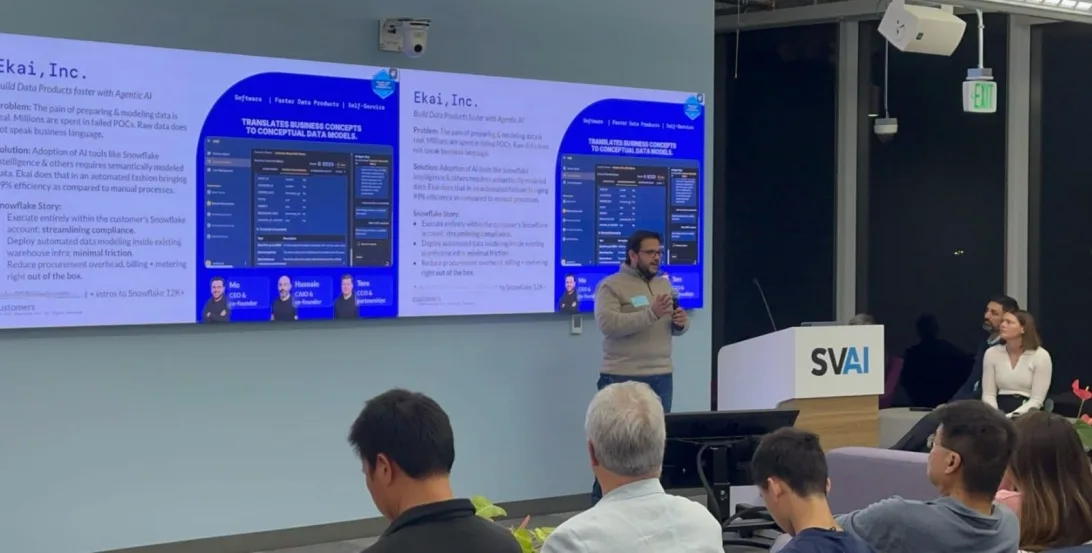 EventLinkedIn
AI adoption requires semantically modeled data and business context for sophisticated AI deployments to work.
Read on LinkedIn ↗ +FeatureSnowflake blog
Snowflake highlights how ekai applies agentic AI to accelerate enterprise data work and deliver faster outcomes.
Read on Snowflake blog ↗JDEach rule has its validation logic in SQL and an expected result. The Data Transformation agent runs the rules when it builds.
one row per ORDER_IDExpected result0 violationsevery REGION_CODE exists in REF.REGIONSExpected result0 violationsAMOUNT - TAX - DISCOUNT >= 0Expected result0 violationsORDER_DATE falls inside the fiscal quarterExpected result0 violationsnet_revenue >= 0 on every orderExpected result0 violationsHow ekai uses agentic AI to automate semantic modeling and turn raw data into intelligent business context.
Read on Medium ↗ EventLinkedIn
Conversations around semantic layers, data products, governance, and building the right data strategy.
Read on LinkedIn ↗Last updated October 28, 2026
ekai is the systems of intelligence layer between your data and your AI agents. ekai learns what your data means by asking the experts who know it, proves every definition against your data warehouse, and publishes it with their name on it, so a data product goes from an idea to production in hours, not months.
Yes. ekai publishes governed semantic models as Cortex Analyst semantic views, so Cortex Analyst, Cortex Agents and Snowflake CoWork answer from the definitions your experts authored and ekai checked against your data warehouse.
ekai is a Snowflake Native App, listed on the Snowflake Marketplace. It runs in your own account, and setup needs ACCOUNTADMIN. ekai is also available as ekai SaaS or self-hosted.
Discovery needs read access. To build semantic models, the Data Transformation agent needs write access to create its own ekai schema, separate from your source tables, where it builds staging views and mart tables. ekai never edits your source tables, and it runs under your roles, your data warehouses and your access policies.
Your raw rows never leave your Snowflake environment. ekai works from metadata and statistical summaries, and the privacy policy sets out what can be shared with the AI providers you use.
 ekai